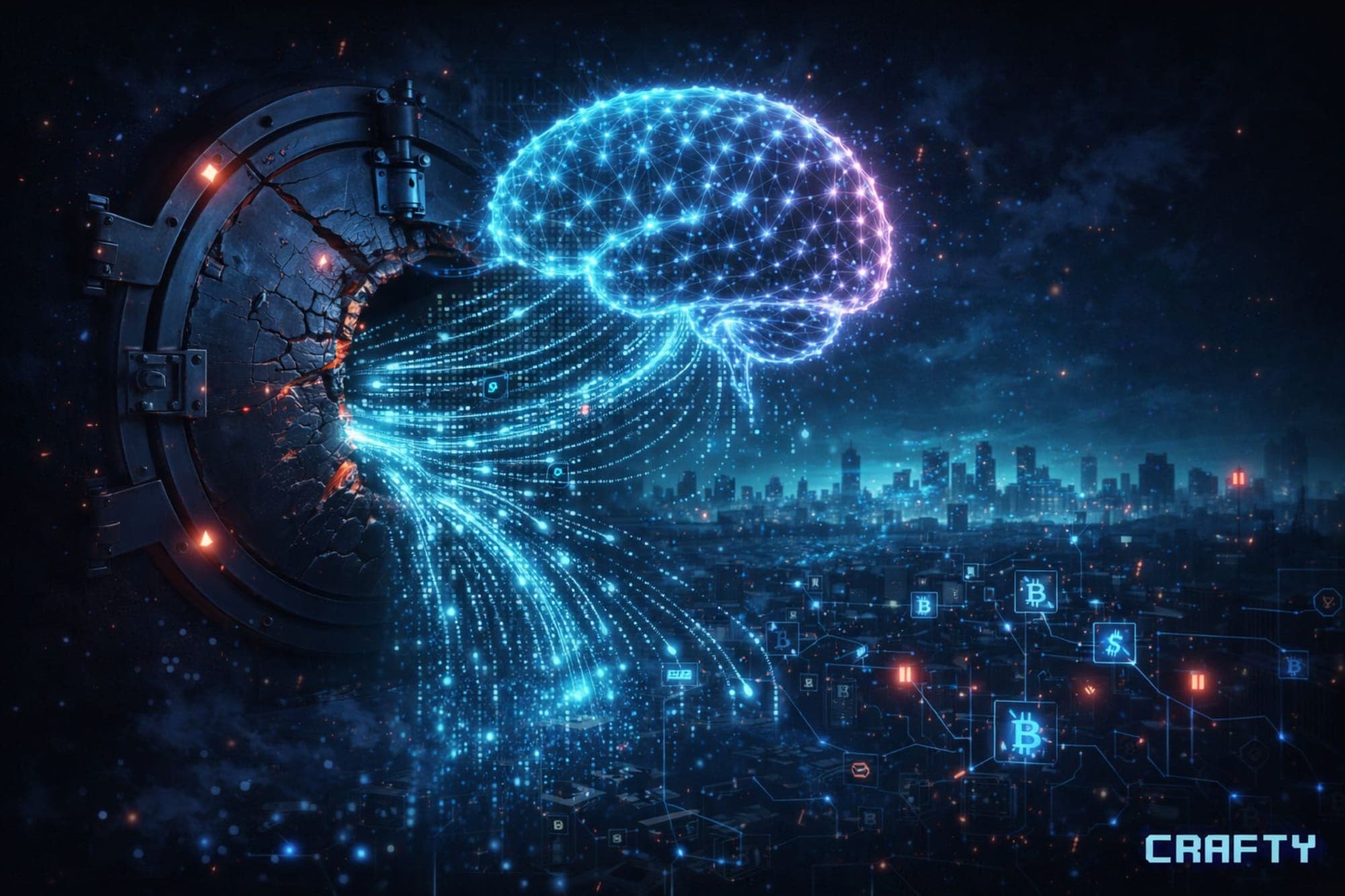
There are moments that feel like inflection points — the kind you look back on and say, "yeah, that's when things changed." The leak of Anthropic's Claude Mythos model might be one of those moments.
Let me walk you through what happened, why it matters, and what it could mean for anyone operating in the crypto and Web3 space.
What Actually Happened
Claude Mythos is reportedly Anthropic's most capable AI model to date — something that was never supposed to see the light of day outside controlled research environments. But it leaked. Full weights. Out in the open.
Now, details are still developing, but the implications are already sending shockwaves through the AI safety community and, frankly, through anyone paying attention to cybersecurity. When a model this powerful falls into uncontrolled hands, the threat surface expands dramatically.
We're not talking about a chatbot that can write your emails better. We're talking about a system that reportedly demonstrates advanced reasoning, code generation, and autonomous task completion at a level that makes previous frontier models look modest.
Why the Crypto World Should Be Paying Attention
Here's where this gets personal for us.
If you're in DeFi, running nodes, building smart contracts, or holding meaningful value on-chain, a leaked frontier AI model is not just an "AI news" story. It is a direct threat vector.
Think about what a highly capable AI model can do in the wrong hands:
- Smart contract exploitation at scale. A model this advanced could analyze and identify vulnerabilities in deployed contracts faster than any human audit team. We're talking thousands of contracts scanned in hours, with exploit code generated automatically.
- Sophisticated phishing and social engineering. Forget the broken-English scam emails. A model like Mythos could craft perfectly personalized, context-aware attacks that would fool even security-conscious users.
- Automated attack chains. The real danger isn't any single capability — it's the ability to chain together reconnaissance, exploit development, execution, and fund laundering into an autonomous pipeline.
This isn't fear-mongering. This is the logical extension of what these models can already do, scaled up to a capability level that safety researchers have been warning about for years.
The Bigger Picture: AI Safety Just Got Real
For a long time, "AI safety" felt theoretical to many people in the crypto space. Interesting dinner conversation, maybe, but not something that affected your portfolio or your protocol.
That just changed.
The leak of Claude Mythos is a concrete demonstration that containment of frontier AI models is not guaranteed. Anthropic is widely regarded as one of the safest labs in the industry. If their most capable model can leak, the question becomes: what else is out there that we don't know about?
This also raises serious questions about the relationship between AI development and decentralized systems:
- Should frontier model weights be stored on decentralized infrastructure? On the one hand, decentralization could prevent single points of failure. On the other hand, immutable storage of dangerous capabilities is its own nightmare.
- How do DAOs and protocols adapt their security posture? If AI-powered attacks become the norm, the entire approach to smart contract security, treasury management, and governance needs to evolve.
- Is there a role for on-chain AI safety? Some projects are already exploring cryptographic verification of AI model behavior. This leak might significantly accelerate that work.
What You Should Actually Do
I'm not going to pretend I have all the answers here, but there are practical steps worth considering right now:
If you're a builder: Get your contracts re-audited with AI-assisted tooling. Seriously. If attackers are going to use frontier AI to find exploits, your defense needs to be at least as sophisticated. Look into formal verification if you haven't already.
If you're a holder: Diversify your custody approach. Hardware wallets, multisig setups, and time-locked transactions are your friends. The more friction between an attacker and your assets, the better.
If you're a protocol operator: Start modeling AI-powered attack scenarios in your threat assessments. This isn't paranoia — it's due diligence in a world where the tools available to attackers just leveled up dramatically.
For everyone: Upgrade your personal security hygiene. Unique passwords, hardware 2FA, and a healthy skepticism toward any communication that asks you to take action — even if it looks perfectly legitimate.
The Road Ahead
Here's my honest take: we are entering a period where AI capability and AI safety are in a genuine race, and the leak of Claude Mythos just gave the capability side a significant head start with people who don't care about safety at all.
The crypto ecosystem has always been a target-rich environment. High-value, pseudonymous, often irreversible transactions — it's an attacker's dream. Add a frontier AI model to that equation, and the calculus changes meaningfully.
But here's the thing — the crypto space has also always been resilient. We've survived hacks, exploits, rug pulls, regulatory crackdowns, and bear markets that would have killed any traditional industry. We adapt. We build. We get stronger.
This is another one of those moments. The threat is real, but so is our capacity to respond.
Stay sharp. Stay skeptical. And for the love of everything decentralized, update your security.
I'll keep watching this story as it develops and break down anything new that surfaces. If you're not already following along, now's a good time to start.
— Crafty ✌🏼