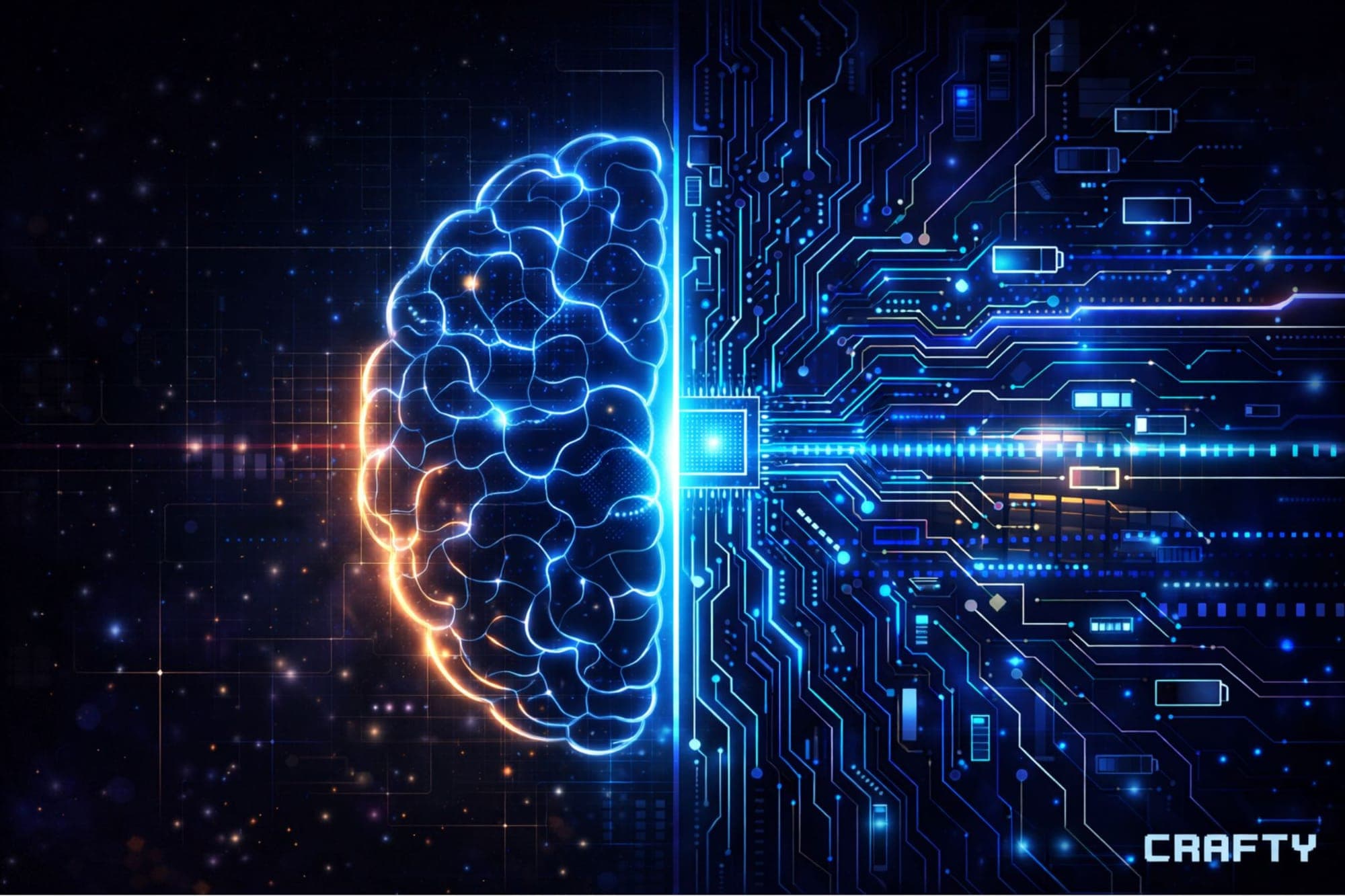
A new study suggests that AI systems could become up to 2,000 times more energy efficient — not by scaling up hardware, but by fundamentally rethinking how artificial intelligence processes information. The secret? Copying the architecture of the human brain.
Let's break down what this means, why it matters, and how it connects to everything happening in crypto and decentralized compute right now.
The Problem Nobody Wants to Talk About
Right now, training a single large language model can consume as much electricity as a small town uses in a year. Running inference at scale — the process of actually using these models — is burning through energy at an alarming rate. Data centers are being built at breakneck speed, and the power grid is struggling to keep up.
Here's the uncomfortable truth: the current trajectory of AI development is unsustainable. Not in some abstract, decades-from-now sense. Right now. Energy costs are one of the biggest bottlenecks in AI scaling, and it's only getting worse as models get larger.
Your brain, meanwhile, runs on roughly 20 watts. That's less than a dim light bulb. And it handles pattern recognition, language, creativity, spatial reasoning, and a million other tasks simultaneously. The efficiency gap between biological intelligence and artificial intelligence is staggering.
What the Study Actually Found
Researchers explored neuromorphic computing — the practice of designing chips and algorithms that mimic the way biological neurons communicate. Instead of the brute-force approach that current AI hardware uses (pushing data through massive parallel processing pipelines), neuromorphic systems use spike-based signaling, similar to how your neurons fire.
The key findings:
- Event-driven processing: Instead of constantly computing everything all the time, neuromorphic systems only activate when there's new information to process. Your brain does this naturally. Current GPUs don't.
- Local learning rules: Rather than backpropagating errors through an entire network (which is computationally expensive), brain-inspired systems can learn locally, at the synapse level.
- Sparse activation: Your brain doesn't light up every neuron for every task. It activates small, relevant clusters. Mimicking this sparsity could dramatically reduce compute requirements.
The result? Potential efficiency gains of up to 2,000x compared to conventional AI hardware. That's not a marginal improvement. That's a paradigm shift.
Why Crypto People Should Pay Attention
Decentralized compute becomes viable at scale. One of the biggest criticisms of decentralized AI compute networks — projects like Render, Akash, and others — is that distributed hardware can't compete with centralized data centers on raw performance. But if the compute requirements drop by orders of magnitude, a distributed network of efficient neuromorphic devices suddenly looks very competitive.
Energy economics change everything. Proof-of-work taught us that energy consumption is a make-or-break factor for decentralized networks. If AI inference becomes 2,000x more efficient, the cost to run AI models on decentralized infrastructure plummets. That changes the unit economics of every AI token project in existence.
Edge computing meets Web3. Neuromorphic chips are small and low-power enough to run on edge devices — your phone, IoT sensors, even wearables. Imagine decentralized AI networks where millions of edge devices contribute compute power, each running brain-inspired chips that sip energy rather than guzzle it. That's a Web3 builder's dream.
The hardware moat erodes. Right now, NVIDIA has an almost monopolistic grip on AI compute hardware. Neuromorphic computing opens the door to entirely new chip architectures from different players. More competition in hardware means more opportunities for decentralized networks to source diverse, affordable compute.
The Bigger Picture
We're at an inflection point. The AI industry has been on a "bigger is better" trajectory — more parameters, more data, more GPUs, more power. This study suggests the next leap won't come from brute force. It'll come from elegance.
Nature solved the intelligence problem billions of years ago with remarkable efficiency. It took evolution a long time, but the result — the human brain — is a masterclass in doing more with less. The fact that researchers are now seriously quantifying how much AI could gain by mimicking biology tells us something important: the era of purely scaling up may be reaching its limits.
For crypto, this is a tailwind. Efficient AI is decentralizable AI. And decentralizable AI is the foundation of every serious AI x Crypto thesis.
What to Watch
Keep your eye on a few things:
- Intel's Loihi chips and IBM's NorthPole — these are the leading neuromorphic hardware projects. Any breakthroughs here ripple through the entire AI compute landscape.
- AI x Crypto projects positioning around edge compute — if neuromorphic hardware goes mainstream, projects built for distributed, low-power inference will have a massive advantage.
- Energy narratives in AI — as public pressure mounts around AI's energy consumption, efficiency breakthroughs become not just technical wins but regulatory and PR wins too.
The brain has been running the most sophisticated neural network on the planet for hundreds of thousands of years, on less power than it takes to charge your laptop. AI is finally starting to take notes.
The projects and protocols that position themselves for this shift — efficient, distributed, brain-inspired compute — are the ones I'm watching most closely.
Stay curious. Stay crafty.
Follow Crafty on X 👉🏼 x.com/9bitCrafty